
**** October eNewsletter ****
Happy October fellow SSTARGazers!
We hope October is off to a great start and that you’re enjoying the crisp fall weather! 🍂
This month, we’re excited to share our SSTARBurst videos, upcoming conferences, and new publications, tools, and books —please see the details below.
If you have a workshop, publication, job posting, call for participants, or other announcements you'd like to share with the SSTAR community, we’d love to hear from you!
New Online Submission Form: Please submit your content using the following form:https://form.asana.com/?k=sEXk2Vl4NvJ-Di7eMIUW0w&d=8142059046716. Please select “SSTARGaze Monthly Newsletter” as your Communication Type. Submissions are due no later than five days before the end of the month (e.g., by October 20 for inclusion in the November newsletter). Be sure to include any relevant deadlines.
We’re grateful for your continued contributions to keeping the SSTAR community informed, engaged, and connected!
Have a great day ☀️,
Marie-Michèle Paquette, Ph.D.
Interim Communications Officer
SSTARBurst
Dear SSTAR Members,
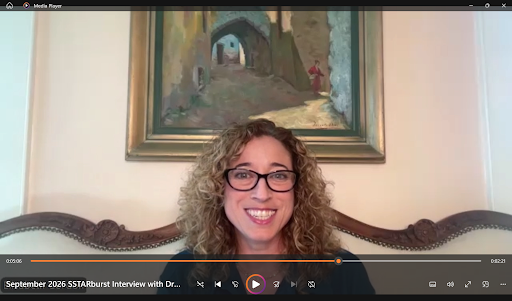
We’re back with another SSTARburst interview, this time featuring psychiatrist, sex therapist, and SSTAR’s current Membership Officer, Dr. Elisabeth Gordon offering her “hot take”: That the lack of integrated sexual health training for health professionals is a violation of biomedical ethics.
Watch Dr. Gordon discuss that because sexual health is an integral part of health, adequately preparing physicians to address it is an ethical obligation.
In this video (and in multiple peer-reviewed publications), she contends that when we fail to train healthcare professionals in sexual health, we leave them inadequately equipped to promote patients’ wellbeing, avoid sexual harms, support informed decision-making, and provide equitable care—placing that educational omission in conflict with all four core principles of biomedical ethics of beneficence, non-maleficence, autonomy, and justice.
Take a few minutes to hear Dr. Gordon’s perspective by clicking on this link to the video.
Then join the conversation: Do you agree? Share your thoughts on the SSTAR listserv!
And if you missed our previous SSTARburst interviews with:
Dr. Jared Boot-Haury
Dr. Marie-Michèle Paquette
Dr. Lyne Piché,
Dr. Bonnie Saks, and
Dr. Jason Winters, you can find them here.
What is SSTARburst?
SSTARburst is a series of short video interviews—perfect for your lunch break—each spotlighting a different SSTAR member and featuring their recently published research or practical, real-world clinical or professional insights. It's all about getting to know one another, celebrating the incredible work of SSTAR members, keeping you current on research and clinical or professional practice, and building connection, collaboration, and community.
We hope you enjoy this month’s SSTARburst—and that it sparks some conversation!
Warmly,
Carolin Klein, Programs Officer
and the rest of the SSTAR Team
Conferences, Workshops, Training, and Webinars
Dear SSTAR members,
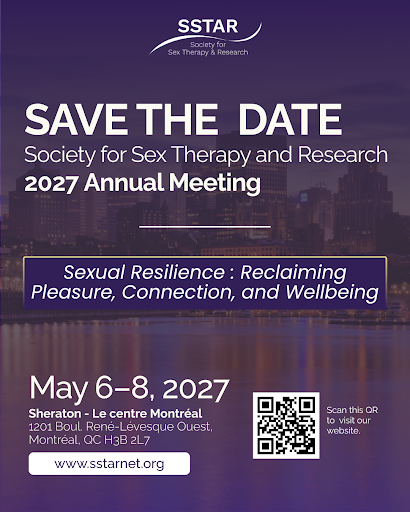
We are excited to invite you to submit an abstract for the 52nd SSTAR annual meeting to be held in Montreal from May 6 to 8, 2027!
The theme of the 2027 annual meeting is Sexual Resilience: Reclaiming Pleasure, Connection, and Well-Being. Abstracts on all sexuality-focused empirical research, clinical observations, and theoretical formulations are welcome, and we particularly encourage submissions that align with this year’s theme.
The deadline to submit is Friday, November 13, 2026.
Please review the Submission Guidelines here
You can also find the Submission Guidelines at: https://sstarnet.org/2027-annual-meeting
You may submit an abstract in one of two categories:
- Research-focused abstracts
Must also clearly identify the clinical implications of the findings and show methodological rigor.
- Clinically-oriented abstracts
Must clearly articulate how the content is grounded by or meaningfully connected with existing empirical or theoretical frameworks.
GENERAL GUIDELINES FOR ALL SUBMISSIONS
- All abstracts must be well-structured, clearly written, and in English.
- The max word length is 300 words, not including author information, learning objectives, and references (these are entered separately).
- To comply with CE/CME requirements, all submissions should include 3 learning objectives and 5 references. Detailed instructions are provided in the Submission Guidelines linked above.
- We encourage strong evidence-informed contributions that are clearly positioned within the broader research or clinical discourse.
- Submissions that are solely anecdotal or insufficiently contextualized within existing literature will not be considered.
- Abstracts, and accepted posters and presentations, should align with SSTAR values.
SUBMITTING YOUR ABSTRACT
- Abstracts must be submitted here.
- We are using CE-GO, an online submission platform that helps with managing CE/CME. After clicking the link, you may have to create an account with CE-GO to submit.
- To meet requirements for CE/CME, all presenters will be asked to include their CV/resume and complete disclosure statements in CE-GO.
- Please follow instructions in CE-GO and the linked Submission Guidelines when preparing and submitting your abstract.
For questions, please contact the Conference Chair at conferencechair@sstarnet.org
Dear SSTAR members,
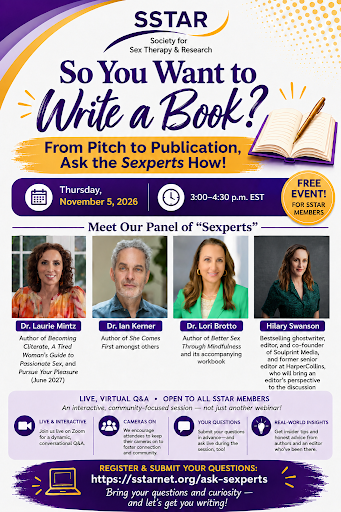
I’m excited to share a new initiative designed to give SSTAR members the opportunity to ask questions, spark conversations, and learn directly from experts in the field: our “Ask the Sexpert” Q&A series is about to launch!!
DATE: Thursday, November 5, 2026
TIME: 12:00–1:30 p.m. PST / 3:00–4:30 p.m. EST
TOPIC:So You Want to Write a Book? From Pitch to Publication, Ask the Sexperts How!
PANEL OF “SEXPERTS”:
- Laurie Mintz — author of Becoming Cliterate and A Tired Woman’s Guide to Passionate Sex, with a third book forthcoming
- Ian Kerner — author of numerous books, including She Comes First, He Comes Next, and So Tell Me About the Last Time You Had Sex
- Lori Brotto — author of Better Sex Through Mindfulness and its accompanying workbook
- Hilary Swanson — bestselling ghostwriter, editor, and co-founder of Soulprint Media, and former senior editor at HarperCollins, who will bring an editor’s perspective to the discussion
Ask the Sexpert” will be a live, virtual Q&A exclusively for SSTAR members, offering an opportunity to engage directly with experts in the field and connect with fellow SSTAR members. Members will have the opportunity to submit questions in advance, as well as ask questions and participate in the discussion during the live session.
Mark your calendars and join us for this new SSTAR member benefit! We look forward to seeing you there!
To register: https://www.sstarnet.org/ask-sexperts
Carolin Klein, Programs Officer
and the rest of the SSTAR Team
Dear Friends & Colleagues,
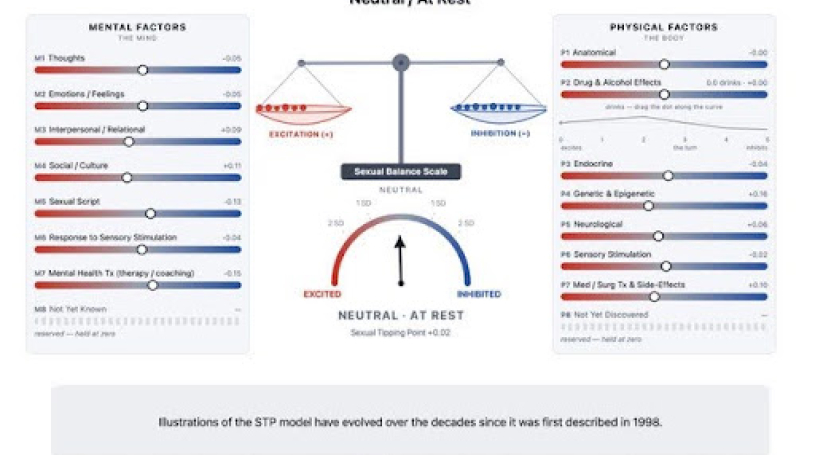
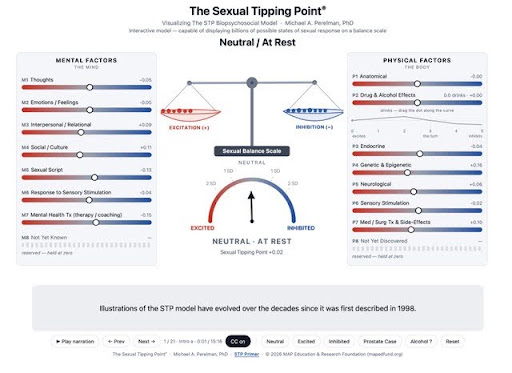
Inspired by H.S. Kaplan’s 1995 sketch, the Sexual Tipping Point illustrations have evolved over the years since it was first taught at Cornell Medicine in 1998.There are two new Sexual Tipping Point video images and tools available for free download and use by all. Both were created in response to clinicians’ requests for a shorter resource than the comprehensive STP Primer. That complete repository was recently launched also for free download with the support of SMSNA and EVAL Health.
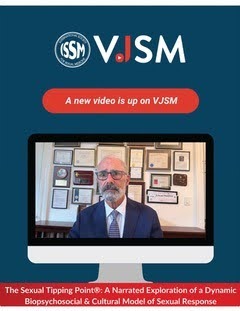
1. A 15 minute narrated and animated video that explains the STP model’s components and demonstrates its clinical application; including a prostate-treatment case illustrating how simultaneously occurring excitatory, inhibitory, and disinhibiting influences shape sexual response. Disinhibition is especially observed in response to the question, “how does alcohol impact sexual response.” The video is citable as Perelman, MA. The Sexual Tipping Point®: A Narrated Exploration of a Dynamic Biopsychosocial & Cultural Model of Sexual Response, Legends Series, Video Journal of Sexual Medicine, September 2026.
2. A companion interactive video version (https://mapedfund.github.io/stp/) can also be downloaded for free that allows viewers to manipulate the model’s factors and observe how both mental and physical factor changes shift the tipping point.
As an aside, almost all of my publications, and most of my presentations, from fifty years of teaching, research, and practice are available for free download at mapedfund.org.
My hope is that some of that work might serve you, and your patients/clients well for decades to come.
Best to all—Mike
Michael A. Perelman, Ph.D.
27 Otter Rock Drive
Greenwich, CT, 06830
EMAIL: drpnyc@mac.com
Tel: 203-622-5000
Director Emeritus, Human Sexuality Program
Clinical Professor Emeritus of Psychology in Psychiatry
Former Clinical Professor of Reproductive Medicine & Urology
Weill Cornell Medicine | NewYork-Presbyterian
&
Founder & Chairman
MAP Education & Research Foundation
70 East 77th Street, Suite 1C
New York, N.Y. 10075 USA
Telephone: 212-570-5000
Website: mapedfund.org
Email: michael@mapedfund.org
The MAP Education & Research Foundation is an approved 501(c)(3) public charity.
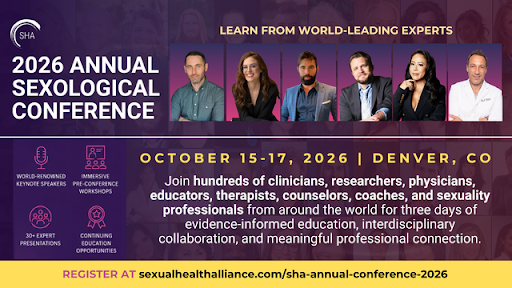
Where Sexology Leaders Gather
Every year, the Sexual Health Alliance Annual Sexological Conference brings together some of the brightest minds in sexual health to explore emerging research, practical clinical strategies, and the conversations shaping the future of the field.
Join clinicians, researchers, educators, physicians, therapists and sexology professionals from around the world for three days of expert education, experiential learning, and meaningful connection. Learn from internationally recognized keynote speakers and more than 50 presenters while engaging in interdisciplinary conversations designed to advance clinical practice, research, and professional growth.
Whether you're looking to deepen your expertise, expand your professional network, or discover new perspectives shaping the future of sexology, the 2026 SHA Annual Sexological Conference offers an immersive learning experience unlike any other.
CME, APA, AASECT, NBCC CEs Available
October 15–17, 2026 | Denver, Colorado
New Publication
Dear SSTAR members,
I'm glad to share a recent publication that may interest SSTAR members who work with problematic sexual behavior.
“Applying the Problematic Sexual Behavior (PSB) Framework to Group Therapy,” published in Sexual Health & Compulsivity, describes a group therapy model I have used for more than 15 years, built on the Problematic Sexual Behavior (PSB) Framework. The group brings together clients who do and do not identify as “sex addicts” and works from what their behavior has in common rather than from a diagnosis only some of them accept.
The framework underlying the model offers a descriptive, non-pathologizing way to assess sexual behavior across five domains: commitments, values, self-control, responsibility, and consequences, without requiring a single theory of cause. Its etiological flexibility may make it useful as shared language across addiction, compulsivity, and sexual-health approaches to problematic sexual behavior.
I would welcome conversation with colleagues curious about the framework or the group model, whether for clinical use, teaching, or research collaboration.
Herring, B. (2026). Applying the Problematic Sexual Behavior (PSB) Framework to Group Therapy. Sexual Health & Compulsivity, 1–20.
https://doi.org/10.1080/26929953.2026.2683197
Bill Herring, LCSW
bill@billherring.com
Book and Award 📚🏆
SSTAR Sandra R. Leiblum Student Research Award 🏆
The SSTAR Sandra R. Leiblum Student Research Award recognizes outstanding scholarly work by students and trainees developing careers in sexuality and sexual health. The award aims to support the professional development of emerging scholars in the field.
Eligibility
Submissions are invited from full- or part-time students and trainees who, at the time of submission, are enrolled in an accredited graduate degree program, postdoctoral fellowship, internship, residency, or fellowship sponsored by a recognized institution of higher education or an accredited teaching hospital or health facility.
Submission topics
Submissions may consist of any unpublished scholarly work focused on sexuality or sexual health, including the understanding, assessment, treatment, or prevention of sexual concerns. Examples include:
- Empirical research reports
- Critical reviews of the literature
- Treatment protocols
- Theoretical analyses
- Teaching program development
Submission requirements
To be considered for the award, please submit the following documents to the Leiblum Award Chair, Dr. Noémie Bigras, by email at noemie.bigras@uqo.ca:
- Cover sheet: Please complete the standardized cover sheet and submit it with your manuscript. The applicant’s name should appear only on the cover sheet, and all co-authors must sign the cover sheet prior to submission.
- Manuscript: The manuscript should be double-spaced and include references to the relevant literature. An abstract of no more than one page should appear on the first page. There is a 30-page limit for the text, excluding the abstract, references, tables, and figures. To ensure a fair and equitable evaluation process, all submitted manuscripts must adhere to APA 7th edition formatting guidelines, including 1-inch margins, an APA-approved font (e.g., Times New Roman 12-point, Arial 11-point, or Calibri 11-point), double spacing, and consistent formatting throughout the manuscript. All submissions must be de-identified (i.e., masked for review).
Selection Criteria: Submissions for the Sandra R. Leiblum Student Research Award will be judged by a committee of SSTAR members on originality, scientific and/or professional quality, written presentation, and contribution to the research and/or clinical fields. All applicants can expect to receive an email from the Leiblum Award Chair about the results of the award by mid-December.
Award: The recipient of the Sandra R. Leiblum Student Research Award will be asked to give an oral presentation of the submitted manuscript at the next SSTAR Annual Meeting, typically on the final day of the conference. At the time of the presentation, a plaque and cash award of $100 will be presented. Additionally, the award recipient will:
- Have their travel expenses, conference registration, and hotel accommodation (2 nights) covered for the annual meeting.
- Receive a free, one-year, student membership, pending application approval by SSTAR.
- Be asked to acknowledge the Sandra R. Leiblum Student Research Award in any future publication of the paper.
- Serve on the review committee for the next year of the Sandra R. Leiblum Student Research Award. This involves reading and scoring of a subset of the submissions on a pre-set rubric.
Individuals who submit a paper for the Sandra R. Leiblum Student Research Award but are not selected for the award will be given a free, one-year, student membership, pending application approval by SSTAR.
Deadline:Monday, October 19, 2026 at 11:59 PM Central Time. Applications received after this date will not be considered for the award.
*Reminder* All individuals who wish to be considered for a presentation (oral or poster format) at the SSTAR Annual Meeting must submit a separate abstract for consideration. Please follow the submission instructions and separate deadline in the SSTAR Call for Abstracts from the Scientific Program Co-Chairs.
If you have questions about the SSTAR Sandra R. Leiblum Student Research Award, please contact the SSTAR office at info@sstarnet.org.
Dear Colleagues,
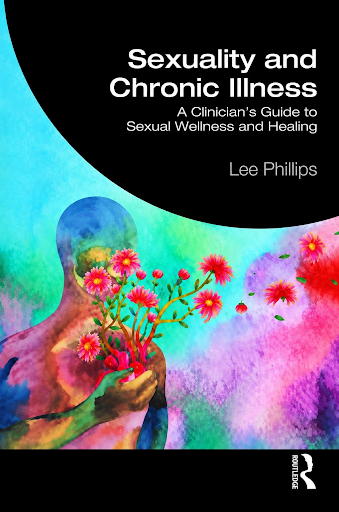
Sexual health also includes understanding how illness, disability, medication, hormones, aging, trauma, relationships, and mental health can affect sexuality. That is why I am excited to share an upcoming professional project that has been especially meaningful to me: my book, Sexuality and Chronic Illness: A Clinician’s Guide to Sexual Wellness and Healing,will be released on December 7, 2026. You canpre-order it now!
Throughout my years as a psychotherapist, sex therapist, educator, and clinical supervisor, I have seen how frequently sexuality becomes overlooked when clients are living with chronic illness, disability, pain, medical treatment, and changes in physical functioning. While clinicians may feel comfortable addressing the psychological and relational effects of illness, conversations about sexual desire, pleasure, intimacy, body image, sexual functioning, and erotic identity can still be difficult to initiate.
Sexuality and Chronic Illness was written to help bridge that gap.
The book offers clinicians a practical, sex-positive, biopsychosocial framework for understanding how chronic illness can affect sexuality across the lifespan. It explores the intersections of medical conditions, medications, mental health, relationships, sexual functioning, identity, body image, grief and loss, communication, pleasure, and sexual adaptation.
Importantly, the book also approaches sexuality and chronic illness through an intersectional lens. People do not experience illness, disability, sexuality, or healthcare in isolation from the other identities they hold. Race, ethnicity, culture, gender identity, sexual orientation, age, socioeconomic status, relationship structure, disability, spirituality, and other dimensions of identity can profoundly influence how individuals understand their bodies, experience sexuality, access healthcare, encounter stigma, and navigate intimate relationships.
For clinicians, this means moving beyond a one-size-fits-all model of sexual wellness. The book considers how identity, culture, power, privilege, marginalization, and systemic barriers may shape a client’s experience of both chronic illness and sexuality. It also encourages clinicians to remain attentive to the ways our own assumptions about bodies, relationships, gender, ability, sexual functioning, and what constitutes a “healthy” sexual life can enter the therapeutic space.
A central message of the book is that sexual wellness is not simply about restoring sexual functioning to what it was before illness. For many clients, healing involves grieving changes, challenging assumptions about what sex is “supposed” to look like, adapting to the realities of the body, expanding definitions of pleasure and intimacy, reconnecting with sexual and relational identities, and developing a sexual life that feels meaningful within the context of illness.
My hope is that this book will be useful to psychotherapists, sex therapists, couples therapists, social workers, psychologists, counselors, physicians, nurses, rehabilitation professionals, and other providers who work with individuals, couples, and relational systems navigating chronic health conditions.
I’m very excited to finally begin sharing this work with the professional community, and I look forward to providing additional publication and ordering information as it becomes available.
Thank you to the many colleagues, clinicians, supervisees, and clients whose conversations over the years have continually reinforced the importance of making sexuality, identity, pleasure, and intimacy part of whole-person healthcare.
Warmly,
Dr. Lee Phillips
Lee Phillips, Ed.D., LCSW, CST-S, CSCT, CPST
Pronouns: He/They
Licensed Psychotherapist (DC, MD, VA, NY, NJ, CT)
Licensed Telehealth Provider (FL)
AASECT Certified Sex Therapist & Supervisor
ISTI Certified Sex & Couples Therapist
ISTI Clinical Integrative Supervisor
IAPST Certified Psychosexual Therapist
Dating, Sexual Wellness, and Relationship Coach
Actor, Comedian, and Writer
Email: drleephillips@gmail.com
Website:www.drleephillips.com
“You have to go the way your blood beats. If you don’t live the only life you have, you won’t live some other life; you won’t live any life at all."- James Baldwin
My book, Sexuality and Chronic Illness: A Clinician's Guide to Sexual Wellness and Healing, will be published on December 7, 2026.Pre-order it here!
Contact SSTAR
Email: Info@sstarnet.org
Phone:(847) 647-8832
